Sunday, February 04, 2007

South Bend Favorites

Farmers Market: We are officially regulars at the Farmers Market. A few weeks ago Bonnie gave us a dollar off on the price of a whole pecan pie we had preordered from the diner “because we are regulars.” This makes me feel, human.

We go to the Market every Saturday. Although it opens at the crack of dawn, we usually make our way there by 1:00 for a late lunch and shopping. We always eat in the diner first. We sit at the second horseshoe-shaped counter, where Sharon is our waitress. (I see Sharon more than I see my Mom.) Our two favorite dishes: The cheeseburger (see entry on best burger in South Bend) and the Market Omelet. The Market Omelet has it all: stuffed with fresh vegetables, cheese, and hash browns and smothered in sausage gravy. Oh yes. It is enough for us to share. I like to sprinkle a little Tabasco sauce on my half. Oh boy.

After lunch we make the rounds at the market stalls. We typically buy blue cheese, apples, and caramel corn (with nuts). We buy garlic and eggs from the Hungarian. The polish lady has the BEST pumpkin pies. We buy Christmas wreathes, pussy willows, and tulips as the seasons bloom. I salivate over the smell of fresh pretzels made by the Amish family. I buy a small container of freshly ground peanut butter (ground right before my eyes!). We pet the puppies up for sale. Once we even lucked into a batch of freshly prepared homemade tamales. We buy homemade candles and soap. We buy what we need and what the season has to offer. Concord grape season and asparagus season are always way too short for our taste buds.


Favorite Burger:
Each burger is unique and fulfills a particular burger-need. Yet I have to go with the Farmers Market Burger as my best. Here is why: while the beef is satisfactory, the vegetables win it. In my opinion, it is the whole package that counts. The Market Burger has a thick ring of white onion, a tomato slice, crisp lettuce, and pickles served with each burger. I add my smidgen of condiments (ketchup, mustard and a smear of mayonnaise), layer the veggies, stack the slightly toasted white bun on top, give a gentle squeeze to the architectural wonder, and bam. There it is. And the portion size matters too. I can eat my burger and feel like I have room to share a slice of cherry pie if I so desire. While CJ’s burgers are sublime, there is also enough meat there to satisfy my yearly quota. CJ’s is legendary. Don’t get me wrong, I love their beef and the onion rings are perfection in a world of fried-vegetable disappointment. But I can do CJ’s once a year. I could handle the Farmers Market burger weekly. There it is. Disagree if you wish. And, by the way, the famous Redamak burger, doesn’t turn me on (and it is not in South Bend). The burger needs its vegetables. And those sad misguided burgers served with (gasp) red onion, forget about it.


Best Ice Cream:
Hands down: Chicory Café in downtown South Bend. Trust me. They serve up handmade fresh gelato with a rainbow of flavors to entice and enchant you—deep chocolates and fruit concoctions that burst with flavor. Walk right past the Chocolate Factory (which has other strengths to be sure) and head to the Chicory Café for your dose of ice dream. Again, there might be some who swear by the Cold Stone Creamery. Their offerings appear voluptuous, but they always fall flat for me. They disappoint or, worse, leave me feeling bloated and guilty. The gelatos at Chicory are pure and simple and divine. No need for add-ins or sparkles or jaunty tunes sung by the underpaid teenage staff. Don’t be fooled by quantity. Go for flavor.


Favorite Café for Writing: This is a tough call. I have to go with The Victorian Pantry--locally owned business, real mugs, help yourself coffee canisters, free wireless, delectable food, wooden tables. But. It is bit too far to drive and technically not in South Bend (it must be Granger, I think.) Slightly closer, but still in Mishawaka, I have to go with Panera which has the coffee buffet, real mugs, tasty treats, wireless, etc., but it is a chain restaurant. In South Bend, you can pick between the Chocolate Cafe and Chicory Cafe, neither of which offer the endless help yourself mugs, although they have wireless. And the coffee at Chicory might just be the best in South Bend (plus they have that remarkable gelato).


Favorite Café:
Lula’s Café. It is the real thing. The house salad, the hummus, the sandwiches all satisfy. No wireless, but this is a good thing. I go there when I need to seclude myself from internet distractions. Coffee served in ceramic mugs, a stellar plus. (Plus I met the man I eventually married there. I was sitting next to the middle window and he was at the table next to me. Ah caffeine-induced romance.)


Best Brunch (and Beer): Fiddler's Hearth. We are regulars here for Sunday brunch. I love their beer, but we don’t get there very often during beer-drinking time. Menu favorites: Shepherd’s Pie and Fish-n-Chips. We go for the Sunday brunch: live music preformed by talented artists, delicious breakfast and lunch foods, and the Sunday papers read on wide wooden tables. Sunday, lovely Sundays.

What are your South Bend favorites?
Any hidden jewels or regular haunts?


Tuesday, January 16, 2007

Ode to Book Club

At least, a prosaic one.

The ladies are headed to my house this evening for our monthly book club. In our book club, we meet once a month. We rotate houses. We meet at 6:30 pm on a weeknight. We pay dues, which are tucked away into a cookie jar. When we have enough cash, we splurge. (Two years ago we went to the beach for a winter weekend of fine dining, hot tubbing, and book talk.) In our book club we have seven members, ages ranging from the thirties to the several decades wiser than thirties. We highly value this mixture of spunk and spit (or spit and spunk, really). In our book club, the hostess prepares a homemade meal (often lavish, but not required) from scratch and uses her good plates. Often the hostess will prepare food that fits the setting of the novel. In our book club, we have "check in", meaning we move around the dinner table telling what has happened in our lives since last book club. (Years of personal narrative add up to a rich tapestry. Ugh, that was so cheesy, but true.) We save our book discussion for after dinner. The leader, who selected the book, gets us started, often providing an author's biography or other salient details. Sometimes she uses prepared reading guide questions. Often, she just says (the equivalent of) "Go!"

Thursday, January 11, 2007

American Idol for Authors

This is it: Gather.com is sponsoring an author's showdown. Post your novel on the their site and it might just be voted the next American Masterpiece. Or even nail you down to a publishing contract. Doubt your deft handling of plot and characterization? Harbor illusions of literary genius? Don't spend another moment in a dither. Take it to the readers.

The way it works: Forget about that dented manuscript scattered in chapters around your house, in your car, and at the bottom of your to-do list. You won't even need to print off a fresh hot-ink perfumed version. E-mail your full-length commmerical fiction manuscript to Gather.com. You must be 17 (or older) to submit yourself to your reading audience.

They will publish your novel online one chapter at at time. And the reading public will vote to keep you alive (or vote to eliminate you, I mean your novel). If you survive three rounds of voting and are chosen the next American Author-to-be-published, you will receive assorted cash prizes AND a publishing contract. Beware: by entering the contest you agree "that if you are selected as the Grand Prize Winner, you will sign Simon & Schuster’s standard publishing agreement within five days of receipt of the agreement."


Monday, January 01, 2007

New Year's Day Menu

French Meat Pie
by Sister M. Concepta Mermis
(with my commentary in blue!)

31/2 lb. ground pork
1 lb. ground beef
2 tsp. salt
3 tsp. cinnamon
1/2 tsp. pepper
1 1/2 tsp. ground cloves
1 tsp. celery salt
1 c. dry bread crumbs (or more)
1 onion

Cook meat and 1 onion in water to cover meat, simmer about 45 minutes to 1 hour. Break up the meat with a wooden spoon as it cooks. Remove onion and discard--even though it must be very, very tasty. Set aside to cool. Let cool (possibly over night) until the fat congeals on top.

Skim off grease (use to make pastry). Making the pastry shell with the grease from the meat is possible and delicious, but has reduced me to tears. I use store-bought pastry shells. Add bread crumbs and seasonings. You may need to add more bread crumbs. Put meat mixture into pastry shell, top with crust. Slit the top of the crust to allow steam to escape. Bake on cookie sheet or foil in case the pie bubbles over. Bake about 35 minutes or until brown in 400 degree oven. Let stand about thirty minutes before serving.

Makes enough meat filling for 3 - 4 pies. At least that is what I have written in my family recipe book according to mom's directions. Except that I HALVED the recipe and still got two pies. So really there is generous meat for 4 (8- inch) pies.

This year I bowed to pressure and added "Hungarian" spices to one of the pies. I used a hefty dose of paprika and two garlic cloves added in large wedges (meant to be fished out for the faint of heart), leaving out the cinnamon and cloves, of course. It was decent, especially with a dollop of sour cream. But it is not French meat pie. It is not New Year's Day.

Serve with creamed peas (and/or corn) and mashed potatoes. Pour the creamed peas over the slice of meat pie for the proper presentation.

Although I grew up eating (or choking down) black-eyed peas for good luck, I left them off the menu today. Living on the edge. Tempting the legume fates.


Thursday, December 28, 2006

Christmas Traditions

In the Hungarian tradition Saint Nick arrives to fill your shoes in early December. The angels bring your tree and gifts on Christmas Eve.

Since our little angel spends Christmas in New York, we have another Christmas with him a few days after the calendar dictates. This provides an excellent opportunity for community building.

The problem: we need a tree after Christmas. You can't even buy fresh cranberries anymore. I tried. I got the canned instead.

The solution: Our neighbors take down their tree the day after Christmas and leave it for us on their front lawn.


We trudge down the block, me in my tree-collecting monstrosity of a Wild Tibetan hat, the others with thick gloves to protect against pine needles (which are decidedly dried out by this time in the tree's decorative life). It is a short block back to the house with our needle-shedding prize.

Thus, the recycled tree is reincarnated in our living room. We decorate it with szalon cukor candies (yummy zseles are our favorite) and knotted strings of orbular lights. Later, when we leave the house for a walk around the block, the angels visit us and leave our gifts. Now that is a holiday tradition.


Sunday, December 24, 2006

Post Argentina From Kansas

This post is penned from my home state, Kansas. I returned to Indiana on Tuesday from Buenos Aires, went to work on Wednesday, Thursday, and Friday, and then flew out from Chicago home to Kansas on Friday evening. I know O'Hare too well these days.

Buenos Aires deserves several extensive posts. Right there on the back of the travel guide it says it all: "Paris of the South, cafe on every corner, thick steaks, and fashionable boutiques." And yet until you walk its vibrant streets and dine on great slabs of grilled meat that bring back your faith in the virtues of beef, you can hardly believe the jewel that it is.

We stayed in a wonderful little hotel called 1555 Malabia (which is also its address) in an area of town called Palermo SoHo. The streets are crowded with cafes, restaurants, and designer boutiques. In another part of town they have the high-end international brands (Armani, etc.). Our neighborhood had local Argentine designers and the style and price ratio are literally overwhelming. Avoid the gorgeous malls, head straight for Palermo.

Of all the wonders we engorged ourselves on during our brief few days there, one of the highlights was definitely our night of tango at La Viruta, which is located minutes from our hotel in the basement of a cultural house. This is where the Argentines go to dance, and where the ex-pats go to learn. We managed to reserve a table and ordered a bottle of champagne (a break to heighten our enjoyments of the Argentine Malbec, a hearty red wine). Soon six couples emerged and strutted across the dance floor to the boisterous introductions of the "leader." We don't speak Spanish. They danced a few numbers and then the whole room assembled into three learning levels for our lessons. We were absolute beginners. It was tense at times--trying to smile our way into a clearer example via body language. But we managed to get the steps with a bit of grace to spare.

After the lesson the regular dancing began. Happily the tango numbers were interspersed with American fifties-era style songs which we managed to fake our way through. It was a wonderful night that had only begun as we left the tango place at nearly 1 am.

The rain was a wall of water.

We slipped into a restaurant next door that promised a dry table and middle-eastern food.

We ordered a Malbec and a plate of cheese, soon to be followed by the best halva I have ever eaten (and we eat a lot of it!).

The best part of this new place: A private party of about 20 Greek-Argentines celebrating the end of the school year and the start of summer. We got there as the dancing commenced. This is a restaurant--not the kind of place a group of diners would take over in Indiana, let's say. And these Greeks could really, really dance. We stayed until almost 3 am sipping our wine, watching the Greek goddesses (and one god) circle, weave, dip and "oopah" the night away right before our eyes.

The Greeks could dance, no doubt. Still they didn't come close to the smoldering tango. If only I were Argentine.

Friday, December 15, 2006

24 Hours in Argentina

This will be short. I don´t want to waste my sunshine time clacking away inside the hotel.

This is our second day in Mar del Plata, a beach town about 4 hours drive south of Buenos Aires. Yesterday a young man was making small talk with me (in English). After the first few usual topics, he asked me if I was vegetarian. Odd question unless you know that this is the land of meat. So, we ate meats--blood sausage, chorizo sausage, and a massive steak sliced and grilled before our eyes. Served slighty pink even though they didn't ask how we like it done. They just know. Divine.

We saw tango. Ate manjar (as they call it in Chile, we learned a few years ago). Walked a mile in the wrong direction (not to mention the wrong shoes). Used our umbrella on the beach (because of rain!). I took a nap. Talked to a local, who mentioned that new government restrictions have discouraged cattle production. Took a walk along the port and saw (and smelled) the local population of sea lions (very, very). Toured an aristocrat´s home, now a museum with a fantastic display of jewelry. Saw lots of stone and/or brick houses. Ate more manjar (dulce de leche).

Did I mention the cows ranging across the endless verdant plains? More grass, taller trees than in Kansas. Same oceanic skies as far as the eye can see in all directions.

24 hours in Argentina. More to come.

Sunday, December 10, 2006

Post Bourguignonne

Dear Reader (Hi mom!),

The dinner party was a joy and the boeuf bourguignonne fork-tender and deceptively straightforward. Our guest of honor, G.S., recognized the dish by name, giving me a start because it is generally best to present an unknown dish and capitalize on the surprise factor. Nevermind the non-beef eating guest and the last minute vegetarian.

My next dutch oven adventure: coq au vin.

A nice surprise: I was chatting with my mom about the dinner party and my lack of dinnerware. She was puzzled because she had given me an entire set last April. I had no idea. I thought it was a tea set. I dug into the miles of tissue paper and sure enough there was a beautiful set of china, complete with salt and pepper shakers. It was a perfect setting for our quasi-french meal. It makes me wonder what other treasures I have waiting for me in packed boxes in the attic.

This week: Book Club (our annual Christmas fete), work, and then off to a southerly clime for a few days of honeymoonish type adventures. Sun, red wine, grass-fed beef, tango. . .

My read for the trip: Amy Hempel's collection of short stories and my first goaround with Orwell's 1984. Although Borges may be a better choice. . .

Monday, December 04, 2006

Boeuf Bourguignonne

A few entries ago I mentioned that I was NOT into cooking these days. Famous last words. We are hosting a dinner party and "we" are cooking a fabulous meal for six. Inspired by Julie/Julia: My Year of Cooking Dangerously by Julie Powell and the culinary expertise of M. in Book Club, I am going for that classic french dish, Boeuf Bourguignonne. Alas, I do not own Julia Child's cook book. I will rely on the Joy of Cooking, which is probably a bastardization of the original. It is the best I can do.

I am glad to have the excuse to cook. This occasion has spurred me to buy my very first dutch oven. Up until now, if I saw "dutch oven" in a recipe, I turned the page. Now I can master slow cooked meats (giving me plenty of time to read while I am cooking). The dutch oven is gleaming on my stove top as I sit here and type. I even bought a 10-cup coffee maker so that I can offer coffee to my guests. Domesticity is in the air. It is snowing too.

The meat is marinating. Tomorrow I'll slow cook it. Wednesday is the event.

Boeuf Bourguignonne Recipe
(from Joy of Cooking, with thanks to Cracker Jack'd, who posted it December 13, 2005)

Cut into 2-inch chunks:

  • 2 pounds boneless beef chuck, short-rib meat, or bottom round

Place the meat in a large bowl and add:

  • 2 cups dry red wine (I chose a Beaujolais; Pinot Noir is recommended)
  • 1/4 cup olive oil
  • 1 onion, chopped
  • 1 carrot, peeled and chopped
  • 1 clove garlic, chopped
  • 1 bay leaf
  • 2 tablespoons chopped fresh parsley
  • 1 teaspoon fresh thyme, or scant 1/2 teaspoon dried
  • 1 teaspoon cracked black peppercorns
  • 1/2 teaspoon salt

Stir to combine and coat the meat. Cover and marinate in the refrigerator for 1 hour or up to 24 hours, turning the meat occasionally. Drain the beef and pat dry. Strain the marinade and reserve it and the vegetables separately. Heat a large Dutch oven over medium-high heat. Add and brown:

  • 4 ounces bacon, diced (I plan to subsitute a healthy dollop of zsir-otherwise known as lard- made by my local Hungarian culinary source.)

Remove the bacon, leaving the fat in the pan. You should have at least 2 tablespoons of fat. If not, add some vegetable oil. Return the pan to medium-high heat. Add the beef in batches and brown on all sides, being careful not to overcrowd the pan. Remove with a slotted spoon. Add the reserved vegetables and cook until lightly browned, about 5 minutes. Stir in:

  • 2 tablespoons all-purpose flour

Cook, stirring, until beginning to brown, about 1 minute. Stir in the marinade, then return the beef and bacon to the pan. Bring to a boil. Reduce the heat to low and cook, covered, until the meat is fork-tender, 1 1/2 to 2 hours. Add:

  • 8 ounces mushrooms, wiped clean and quartered (I bought tiny portobellos.....)
  • 8 ounces small boiling onions, peeled (I will use pearl onions as I have no idea what a "boiling onion" might be. To peel the onions: pour boiling water on the onions and let cool. Then cut off the ends and the skin will slip off with a little push.)

Cover and cook until the vegetables are tender, about 20 minutes. (It took longer than 20 minutes for the onions to tenderize. You could saute them in a little butter before adding them to the stew to speed up the process.) Skim off the fat from the surface. Add:

  • 1/4 chopped fresh parsley
  • Salt and ground black pepper to taste

To thicken, you may add in 1 tablespoon kneaded butter (which is butter creamed with flour).


"Heavy" Readers

"For decades, reading studies have repeatedly found that 'heavy readers' not only read more books than light readers and nonreaders but also do more of almost everything else, including traveling, attending sports events and concerts, visiting museums, and participating in community organizations and politics. For many, reading is a way of being engaged with the world. These readers like to know about things and they read to find out."

"Reading Non-Fiction for Pleasure: What Motivates Readers?" Catherine Ross in Nonfiction Readers' Advisory, Robert Burgin (ed)

Sunday, December 03, 2006

A Few Laughs


Friday, December 01, 2006

You Know You're From South Bend When. . .


*this list was forwarded to me by a former Bender,
who claims the author is unknown.


1: You know all about the Snyder scandal and often
refer to Roseland as Snyderville.

2: In middle school, a typical weekend consisted of
hanging out at the movies, but never actually SEEING a
movie....or going "Meijer-ing"

3: You remember when Movies 14 was Movies 10.

4: You hate Penn High School athletics.

5: Favorite graduation party activities include
Cornhole and Euchre.

6: The last week of classes was spent playing cards.

7: You're a die hard Notre Dame Football fan. HELL
YA!!

8: Whenever someone says to meet at either Wendy's or
Taco Bell you always ask "the one on 31 or the one by
the mall?"

9: You tailgate every home game of football season.

10: "Going out" on a Friday/Saturday night means going
to a friend's house to drink.

11: You can't recall the last time we had a snow day.

12: You hate snow.

13: You hate being stuck behind a Michigan driver
because let's face it, they can't drive.

14: You've gone tubing at Saint Pat's Park.

15: You've been to the Niles Haunted House multiple
times.

16: During your last years of high school, whenever
someone asked what your college plans were you said,
"Probably IUSB or Purdue"

17: You've wondered why Old Navy isn't part of
UP...And you know what UP is.

18: You and your friends have taken turns guessing
what the new building on the corner of 31/Cleveland is
going to be.

19: You know what "Nick's" refers to and only ever go
there after 10:30pm.

20: You've either gone can collecting or have had
people come to your door demanding non-perishable food
items.

21: During the summer, 50 degrees is unbearably cold.
During the winter, 50 degrees is scorching.

22: You wear flip flops in the snow.

23: When deciding where to go out for dinner you drive
up and down both Grape and Main.

24: You go to Barnaby's after every high school
football game.

25: You're a frequent ranch and salsa mixer at
Hacienda...and you know what Hacienda is...and it's
your favorite restaurant.

26: You grocery shop at Martins.

27: You see nothing odd about the word "Mishawaka"

28: You go at least 10 mph over the speed limit in the
section of Ironwood between Douglas and 23. Who set
the 30mph limit on a 4 lane road anyway?

29: You went to Franks Red Hots before it became K's.

30: When people ask you where you're from you always
follow "I'm from South Bend" with "*pause* . . . it's
where Notre Dame is"

31: You've ever tried to exaggerate on how cold it is
outside, and the actual temperature is colder than
your exaggeration.

32: You still wonder if the old guy that sits on 31
holding the flag is dead or not.

33: You're still holding a grudge against Joan Raymond
for Plan Z.

34: You remember when Scottsdale Mall was shut down.

35: Your elementary school field trips were spent at
Copshaholm, the Studebaker house, Leeper Park, and
Amish Acres.

36: You consider Mishawaka, Granger, and Roseland all
extensions of South Bend.

37: Driving slowly down Primrose with your headlights
off is a fun, scary thing to do when you're bored.

38: You have always wanted to get the HELL out of here
. . . AND if you did you came back.

39: You know what Dyngus Day is . . . and were
surprised to learn that the rest of the country doesn't.

Wednesday, November 29, 2006

NYT Ten Best Books of 2006


Check out the 10 best books of 2006 according to the New York Times:

http://www.nytimes.com/ref/books/review/20061210tenbestbooks.html?ref=books

Tuesday, November 28, 2006

Argh

I am going through the I-have-too-much-to-write-about-and-
so-I-will-just-be-lame-and-engage-in-avoidance-behaviors-such-
as-contemplating-baking-instead-of-writing script.

Can you say, "
Precipice"?

Although I had a serious case of carrot-cake-baking between the ages of 14 and 15, in general I cook because people need to eat these days. Cooking for the pleasure of it? I have realized that the cheery kitchen fairies who left nary a shoe print one night as they scraped my crusty pans are not REAL, after all. Damn. That means if I dirty it, it stays dirty and slowly--with appropriate sun and moisture--moves into the science experiment phase. I have taken the only measure possible and ceased and desisted from anything resembling a culinary act. Thus, if baking a cake seems more appealing than writing OR reading, then I am teetering on the edge.

This entry is me forcing myself to write. something. anything. Other than what I write for my students. Cryptic notes about MLA requirements do not count as poetry.

I have been reading lately. Even reading in the service of my writing. L.
recommended a new title that sounded similar to my work. I just finished it and am working through a love/hate reaction. The Uses of Enchantment by Heidi Julavits twists and turns around the life of a young narrator whose coming of age entailed an elaborate act of narrative fiction. Mary disappears from field hockey practice and then reappears weeks later. The story revolves around the truth about the events during her absence. Was she abducted? She did purposely hide herself away? Was she raped? She was a virgin, but returned not a virgin. I enjoyed Julavits uses of language and her inventive plot. In the end, however, I just didn't buy into the narrator.

The narrator of my own novel-in-languish is also a young woman still in high school. Julavits' s character narrates the experience from about ten years later, which allows her a level of retrospection that my character doesn't have. Julavits writes in the third person. My choice to tell my character's story in the first person is feeling more and more like a cage instead of a podium. Hhmmmm...to rewrite entirely from the third person? Argh.

In other reading, I also recently finished Eve Ensler's new book, Insecure at Last: Losing it in our Security Obsessed World. Her blunt declarative sentences are brutally honest about her life, her political views, and her various states of insecurity. By the end of the short work, you want to join her movement and give up security in order to allow peace to take hold. If security (think personal integrity AND national security) becomes our first priority, then our stance toward the world is by default a posture of defense. This is the antithesis of peace, which is fundamentally empathic. You can't build walls and dish up bowls of soup at the same time. If you are curious about Ensler's work, read or see The Vagina Monologues. Then read her latest book. It will make you want to be honest with yourself; it may even help you say "Vagina" in unexpected places. Like to your priest. Trust me, he needs to hear it, especially if he is under 40.

(Speaking of Eve Ensler, Me, and Priests. . . remind me to write about that trinity sometime. I've got loads of material.)

Eve. . . and. . . C.S. Lewis. Currently I am reading, really re-reading, Lewis's Till We Have Faces, which retells the Cupid and Psyche myth. I was entranced by this book's exploration of the sacred v. profane theme the first time I read it (maybe ten years ago?). Sacred v. Profane: a false dichotomy! Repeat after me: false dichotomy. That is right. A binary opposite that serves only as a rhetorical flourish! (Hear me rant.) I look forward to our Book Club discussion in December where I promise to try and not interupt others.

And, finally, a note for the anonymous reader who wants to know why I durst to resent a statue. . . I'll post a reply in the comments on that original post. Soon.

Wednesday, November 22, 2006

Poem: Raking by Tania Rochelle

Raking

Anna Bell and Lane, eighty,
make small leaf piles in the heat,
each pile a great joint effort,
like fifty years of marriage,
sharing chores a rusty dance.
In my own yard, the stacks
are big as children, who scatter them,
dodge and limbo the poke
of my rake. We're lucky,
young and straight-boned.
And I feel sorry for the couple,
bent like parentheses
around their brittle little lawn.
I like feeling sorry for them,
the tenderness of it, but only
for a moment: John glides in
like a paper airplane,
takes the children for the weekend,
and I remember,
they're the lucky ones--
shriveled Anna Bell,
loving her crooked Lane.


Provided by American Life in Poetry
Reprinted from "Karaoke Funeral," Snake Nation Press, 2003,
by permission of the author.
Copyright (c) 2003 by Tania
Rochelle.

Monday, November 20, 2006

Protest O.J. Simpson

Last week the YWCA of St. Joseph County made a
public statement (read the statement in the South Bend
Tribune
) reacting to the announcement that O.J. Simpson
will appear in a two-part
special on the Fox television
network, as well as a soon-to-be-released book
detailing
how he "would have" carried out the murders
of Nicole Brown Simpson
and Ron Goldman.

The YWCA has received an overwhelming response from
people wanting to join the protest, and they encourage
people to contact
the following numbers to request
that booksellers not participate in
the book sales, and
that FOX TV not air the special:


Barnes and Noble - Customer Service Center at
1-800-THE-BOOK
(1-800-843-2665).

Amazon - you can send an email via their website
(no really good way to directly connect with them)


HarperCollins (the publisher) - 212-207-7000

ReganBooks - 212-207-7000 (a division of HarperCollins)

FOX - contact the local FOX station 574-679-9758 and/or
fox28news@fox28.com AND the national office
-
http://www.fox.com/links/affiliates.htm AND (310)369-3553

You may also contact big box retailers like Target
(again both local and national office) to ensure they do not
carry the book in stores
or online (their online book service
is provided by amazon).


Spread the Word!

UPDATE!!!!!

O.J. Simpson book and tv show cancelled!
Read the headline.


Sunday, November 12, 2006

Party Ponderings

Throwing a party is good for the general order. When you live day-to-day you can ignore the year's worth of flotsam accumulated beneath the couch cushions.

In fact you go about your evenings perched on the sofa, mug and novel in hand, blissfully unaware of the ecosystem evolving beneath the leather. Suddenly, on an otherwise typical Tuesday night except that it is a Tuesday before the Party on Saturday night, your brain concocts a certain (as yet unnamed, as far as I know) chemical. Somewhere deep in your genetic code an embedded switch triggers a latent domestic skill once witnessed in the childhood home: Lift cushion, Insert vacuum extension device, and Suck up all that lingers there.

And so there I was in my ridiculously purple robe hoovering up paperclips, popcorn kernels, and assorted flora. All for the sake of the general order. No one would look beneath the cushions. Yet it made happy to prepare the way for my guests, especially in such a secret way.

The day before the party, I bought myself sunflowers and arranged them in a vase given to us as a wedding gift from my book club. I should buy myself flowers more often. But somehow it takes a party to think of the indulgence.

When I throw parties, my house is never more radiant. I see it through a guest's eyes and fall in love with the wood beams and chipped plaster walls that desperately need to be painted. That leaky faucet. . . quirky. The needs-to-be-replaced old school linoleum floor. . . perfect for spilled drinks. The Persian rugs emanate color in the candlelight. And that statue I have always resented (yes, resented) seems light-hearted and whimsical.

People talking with vigor (in order to be heard), fancy shoes, colleagues not talking about work, philosophers being chatted up by working stiffs, biologists and high school German teachers a-mingle, writers, graphic artists, professors and former students. . . all mixed up in a tiny house with food catered by Victorian Pantry (it was my first time to have a party catered and and oh boy was it tasty and pretty) and copious libations of all sorts (the tequila defined smooth).

Parties come in all shapes and sizes and fulfill all kinds of functions: celebrations, life-rituals, traditions passed down, etc. But I love me a good-old fashioned Bacchic occasion. No reason needed other than the compulsion to enjoy friends and make new ones. And nibble a bit on the buffet. And watch your friends' babies turn into little people.

Not to mention the decadent feeling of sleeping in the next morning knowing that your couch doesn’t have to be vacuumed until the moon is full once again.

Saturday, November 04, 2006

Borat Bandwagon


Jump on the Borat Bandwagon.

Saturday, October 28, 2006

Never Let Me Go by Ishiguro

For October's Book Club we read Kazuo Ishiguro's 2005 Never Let Me Go. You might recall the Japanese-British author from his novel-turned-film, "The Remains of the Day."

During the long flight between Zurich and Chicago a few weeks ago, I delved into the strange world of children marooned in a private school on the verge of both adolescence and the deep -down biological truth about who they are. Soon they will leave the school and begin their life of work. But their life's work has been pre-ordained and entails their entrails. (Sorry, couldn't help that last word play.)

I won't give too much away here except to say that the children are aware that one day they will become "donors" or "carers" and in the meantime they must produce artwork to please their guardians. The story revolves around three friends who grow up before your eyes slowly, painfully. They move toward their fates with the resigned spirits of those whose free will is compromised. They are calmly reserved, but nevertheless achingly human.

I was not convinced that it would be a good book for discussion. The characters were flat-ish and the science fiction dystopia outside of our usual tastes. I am not sure why I thought this seeing as how Blindness by Saramago was a hit with most of us. Ishiguro's tale is a far "easier" read by comparison.

After a lovely meal of served by our hostess, we moved into a rewarding explication of the text. It turns out that we were unabashedly eager to share our takes on the existential tale and its touchstones with our modern world. I admit: I interrupted, more than once, to make my points.

Here are a few useful sites:

http://www.npr.org/templates/story/story.php?storyId=4629918
NPR site with excerpt from Chapter One and links to audio interviews with the author

http://dir.salon.com/story/books/review/2005/05/06/ishiguro/index.html
Salon.com review


Sunday, October 22, 2006

How Alfred Brendel Changed my Life

When I was younger and abroad for a year of studies in Rome, Italy, the arts--opera, dark churches with Michelangelo's statues lit up with a handful of lira coins, Italian fashion, the Renaissance streets of Florence, the endless hallways of the Louvre in Paris--overwhelmed me.

I worshiped at the feet of the David, succumbed to Verdi's Macbeth, and penned dribble in my journal surrounded by Monet's Water Lilies.

For Christmas, my traveling companion and I had purchased "limited view" tickets to see the Nutcracker in Paris. We stayed up for midnight mass at Notre Dame on Christmas Eve. It was cold, Paris quiet beneath snow, on Christmas morning. We bundled up, groggy and without a cafe in sight open, and headed into the postcard-perfect streets toward the theater.

"Limited view," we found out, translates to entirely-blocked view except for the thrilling bit of tulle gone airborne in the far, far, far left corner of the stage. (Needless to say, I have never been lured into "limited view" tickets again.)

Despite not being able to see the Nutcracker, a highly visual show, my friend and I were ecstatic with joy. We could hear every luscious note. We basked in the joy of the warm theater. (As student travelers in Europe during the winter, cold weather was a constant drag. Yet, of course, blustry winds gave the perfect incentive to stay in cafes or museums, feeding our caffeine and art addictions, respectively).

My year abroad in college was filled with art and conversation. We could pursue our passions with abandon and be rewarded with even more existential questions, a deeper thrill for life with a capital L.

Then life (with a very lower case l) intervened. Years pass. I was still in love with art, still in love with conversation. But life has a way of taking you along, taking you out of yourself. Perhaps this is called adulthood. The escape from constant (sometimes debilitating) self-awareness and longing for meaning with a M.

At any rate, my worship of art and artists remained, unexamined. I play chess like a fourth-grader, because that is when I learned to play. I played intensely and then moved on to other things, like four-square and dodge ball. In much the same way as I am still a fourth-grade chess player, my notion of the arts and artists got frozen in my college era.

Until. No single ah-ha moment to report here. Actually, still in college, I forced myself to read a biography of Rothko because I wanted to "get" modern (i.e. beyond the Renaissance) art. I fell in love with his work, much as I fell in love with just about everything I studied in college. I was an easy girl back then. Give me a book, an idea and I will love it. Period.

Since college I have met modern art fans. I started to go to modern art museums. (Gasp.) I saw a lot of stuff that irked me. I am tired of art that requires me to read the paragraph of drivel (sorry!) that explains it to me, the viewer. I grew tired of video installations that demanded my attention for (long) minutes of time with zero payoff. But.

But, some stuff has blown my mind. Hermann Nitsch, recently, for example. Or made me see the world and its truths more clearly, even when they are uncomfortable truths.

Somewhere along the way, I died my hair deep blue. (It only lasted a few months, but still.)

Then I read the biography of Marcel Duchamp. If you don't know his work, you can not understand modern art--both the Good and shockingly mediocre varieties.

I met some living, working artists. Saw their stuff. Visited studios. I debated with them about "art" and the role of the artists. We drank beer and doodled on napkins.

And finally I got a really whacked idea: write my own novel. And perhaps it is this last endeavor that really changed my relationship with art.

And I suppose I did have one ah-ah moment. It was last weekend in Vienna, over soft-boiled eggs, ruminating on the symphony's performance we had seen the day before. As I worked my way through a monologue about the experience of watching Alfred Brendel work the piano keys for Mozart (no problems with limited view tickets this time!), I put it all together for my patient brunch buddy between bites of yolk smeared on bread, for the first time:

When I was younger and being overwhelmed by art, I thought that superhuman geniuses had created art. (Of course, in some cases, this may be true. I believe in genius.) But now I see that art--painting, sculpture, collage, writing, poetry--is made by humans. Humans in touch with being alive in a fundamental, radical way. And so, I write. I write (create art) and teach because I am compelled by human nature to make art. To consume art. Or at least, the very least, die trying.

(Whew. That was long. I feel better now.)

Thursday, October 19, 2006

What is Beauty?

You may have seen the ads for Dove's campaignforrealbeauty with real women showing off their non-model bodies--illicit curves, bold wrinkles, and plains as God so created them.

What is real beauty? And who gets to decide?

Damn. What a good ad campaign. I wonder if it will actually sell more Dove products? Who cares?

This video is short (less than a minute) but strikes a nerve.

Monday, October 16, 2006

Wien

A weekend in Vienna:

espresso with orange liquor and cream,
boiled rump with apple horseradish, knee-high boots,
brunch everyday,streets crowded with shoppers,
Klimt, apple strudel, the symphony at 11 am, schnitzel,
Freud's House, organ concerts,
blood sausage strudel,
Beneton, Mozart, Genomics,
Mozart torte, dobos torte, The Couch, melange,
important scarves, Secession, Mango,
too much wine at dinner,
whipped cream,
Oberlaa, MQ, Demel, einhahn street,
Budapest but more, wiener,
soft-boiled eggs in egg cups and tiny spoons,
Bauhaus, bicycles, Hermann Nitsch,
bread and butter.

Sunday, October 01, 2006

White Noise by Don Delillo

The writer is the person who stands outside society, independent of affiliation and independent of influence. The writer is the man or woman who automatically takes a stance against his or her government. There are so many temptations for American writers to become part of the system and part of the structure that now, more than ever, we have to resist. American writers ought to stand and live in the margins, and be more dangerous.
Writers in repressive societies are considered dangerous.
That's why so many of them are in jail.

Don DeLillo, from the 1988 interview with Ann Arensberg

I decided to read my first Don Delillo work after I heard Curtis Sittenfeld, author of Prep and The Man of My Dreams (see May 23rd blog entry) mention "White Noise" as her top pick of novels from recent literary history. I believe the New York Times had just published a list of the top novels selected by a list of current authors. The top choice was Beloved by Toni Morrison, which Sittenfeld candidly admitted that she had never read. When she mentioned White Noiseas her top choice, I made a mental note to include it on my reading list.

The first person narrator, Jack Gladney, tells his story with relentless honesty. The world is too much with him, indeed. Technology's comforting white noise is always present. His children have jaded vulnerabilities that make you ache and cringe. His youngest child, Wilder, is too young to speak at all, yet brings the most comfort to the family (and the reader) by simply existing. His needs--food, water, sleep--give human life a simple purpose.

As I read through the increasingly bizarre events, which take place in an all-too-familiar traditional college town, I found myself admitting to my own fleeting (yet real) fixation on my own death and the death of my loved ones. Do you indulge in detailed visions of what-if cancer strikes? What-if the drunk driver hits my car? What-if it is my bag of spinach that carries my deadly calling number? Admit it.

The characters in White Noise often wander the supermarket and ponder its contents and displays for meaning. Delillo's choice to have them observe the supermarketplace was a clever choice as shiny tinfoil packages of snacks can tell an eloquent tale about the America of this era.

My father worked in the grocery industry and so I grew up knowing that there were stories behind how the bananas got to the produce section. I learned that bananas start off as vegetables and end up as fruit. I saw the climate-controlled rooms where bananas are held--frozen in time--until they are deemed ready to ripen for the stores. I used to think this destroyed the poetry behind the apples and oranges. Of course now I realize that seeing behind the display cases was seeing the poetry of the process. As mechanical and ugly as the process may be in comparison to the finished fruit.

Jack and his wife Babette go about their daily lives and deal with an airborne toxic event causing them to evacuate their town beneath a comforting blanket of white noise. Beneath the noise, however, is the ever present fear of death. A fear that drives them to confront or avoid their existence with a fierce determination to escape the fear, even if they can't escape death itself.

While I have not had a chance to discuss White Noise with fellow readers, I have read a few reviews and visited other useful sites:

Crowding Out Death
by Jayne Anne Philips (originally appeared in the New York Times, January 13, 1985.)

New York Times Featured Author: Don DeLillo
This site contains reviews of DeLillo's books and an audio reading and interview.

The Don DeLillo Society
This site contains a bibliography, events, links, and more.

White Noise on White Noise
This site is a fun creation about White Noise.

Here are a few DeLillo quotes about writing:

I became a writer by living in New York and seeing and hearing and feeling all the great, amazing and dangerous things the city endlessly assembles. And I also became a writer by avoiding serious commitment to anything else.
DeLillo to Jonathan Bing, 1997

I write to find out how much I know. The act of writing for me is a concentrated form of thought. If I don't enter that particular level of concentration, the chances are that certain ideas never reach any level of fruition.
DeLillo in an article by William Leith in 1991

Wednesday, September 27, 2006

Literary News

Murakami Wins Short Story Prize
by Lawrence Van Gelder
Published September 27, 2006 in the New York Times

Haruki Murakami of Japan has won the second Frank O'Connor International Short Story Award, a $44,700 prize billed as the world's richest for short stories, The Guardian of London reported. Mr. Murakami is to share his prize for "Blind Willow, Sleeping Woman: Twenty-Four Stories" (Knopf) with his translators, Philip Gabriel and Jay Rubin. When the announcement of the winner was made in Cork, Ireland, the hometown of O'Connor (1903- 1966), the jury hailed Mr. Murakami as "a master of prose fiction," saying he "writes with great integrity, unafraid of dealing with tough and difficult situations between people who constantly misunderstand each other."


Read my January 4, 2006 blog entry about reading Murakami's book, "Kafka on the Shore."


Thursday, September 21, 2006

Updating My Bookshelf

A not too smallish box arrived from Amazon today. This means it is time to update my not so current "current" bookshelf. I'd like to make separate entries about the following titles, but time may not allow.

Recently read:

White Noise by Don DeLillo

Three Junes by Julia Glass

The Bonfire of the Vanities by Tom Wolfe

The Road from Coorain by Jill Ker Conway

Uglies by Scott Westerfeld

It is an eclectic collection.--literary fiction, autobiography, and young adult fiction. I would be happy to tell you more about any of these titles if you would like a preview before you buy.

I've updated my "Current Bookshelf" in the sidebar to reflect my newest obsessions.

Tuesday, September 12, 2006

YWCA and Ten Thousand Villages

support the
YWCA of St. Joseph County

by shopping at

Ten Thousand Villages
919 W. McKinley, Mishawaka
20% of the day's sales will go to the YWCA
10 am-6 pm
Friday, Sept. 22

For more information:
Joann Phillips
Resource Development Director
YWCA of St. Joseph County
1102 S. Fellows St., South Bend, IN 46601
PH (574) 233-9491, ext. 316; FAX (574) 233-9616 jphillips@ywcasjc.org


mark your calendars!

spread the word!


Sunday, September 10, 2006

Club Noma, Downtown South Bend

I had heard the owner of the new Club Noma speak about his plans for the hip new bar and restaurant for several years. Those well laid plans have finally been realized.

Last night we headed downtown South Bend to find some dinner and catch a bit of the Ohio v. Texas football game. The regular haunts were packed and so we gave up on the game and enjoyed the delicious soups at the Chocolate Cafe. Heading home, we noticed the Now Open sign in front of Club Noma. Despite our grungy dress, we couldn’t resist the opportunity to peak inside.

We were greeted with hors d'oeuvre of duck, salmon caviar, and chicken--all tasty Asian fusion morsels, a promise of what the dinner menu holds. The bar is a work of art. The owner's eye for detail is truly extraordinary. The bar attendants are stylish and classy (not to mention hot). The live DJ is turning the tables, backlit by smooth water lights. The music is right on for the hip vibe pulsing through the miniature jellyfish orbs over the bar, the bare brick walls (waiting for their soon-to-arrive neon logo), and blood red leather couchettes. Hot, hot, hot.

And soon the center stage will be taken by an enormous free standing jellyfish aquarium. We all know how mystically gorgeous those creatures are. They captivate with their sensuous arms and transparent bodies. Hot music, throbbing jellyfish, and did I mention the martinis?

I am a classic vodka martini girl, a little dirty, with blue cheese olives. None of those fancy sweet concoctions for me. But you would be surprised how difficult it is to find a good plain old martini--and I am not just talking about our bendy city.

Martini Report Card for Club Noma: A+

While I am a straight up martini kind of girl, Club Noma has a tempting list of martini cocktails. I might have to go for the one with pear in its description. Sounds healthy. I need to balance my olives with a daily fruit serving, per the suggestion of my good doctor.

Congratulations to the owner and staff at Club Noma. Well done.


Applause. Applause. Applause.


The official grand opening will be Thursday, September 14th.

Club Noma description
http://www.opentable.com/rest_profile.aspx?rid=4936

Club Noma
119 North Michigan Street

South Bend, IN 46601
Their website:
http://www.clubnoma.com/

South Bend Tribune Review
September 20, 2006
"New South Bend fusion restaurant reflects a vision"
by Heidi Prescott


Friday, September 08, 2006

Wednesday, September 06, 2006

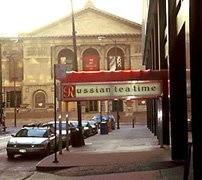
Russian Tea Time

My parents emailed us with the announcement: They had planned a tour of their six children to celebrate their 45th wedding anniversary. This trip would take them a few miles across town, hundreds of miles across the prairie, to Northern Indiana, the East Coast, and the Rocky Mountains within a week. They asked us to pick out a nice restaurant for each night of their weekly weddinganniversarypalooza.

I met them in Chicago and took them to a little place I had discovered a few years ago. It is a Russian restaurant, Russian Tea Time, with old world red velvet drapings, samovars, and nesting dolls. Lots of mirrors and attentive waiters. When I was sixteen, I convinced my parents to let me become a People to People Ambassador. I flew to Moscow and studied biology in Sochi along the Black Sea Coast. I viewed Stalin’s mummified body in great solemnity. I visited a tea plantation and ate fresh raspberries atop a mountain.


I was a sixteen-year-old Kansas girl serving as Ambassador of Peace. It was 1991 and political upheaval was the rule, little did I fully realize as I went about selecting the perfect black-lacquered box as a memento for my treasure chest back home.

So the selection of Russian restaurant to honor my parents’ 45th anniversary was no accident. They gave me Russia, and I thought it would be nice to share a Russian meal with them.

We started with a flight of vodkas—bilberry, cranberry, and plain. These vodkas, served with dark rye bread chunks and pickles, go down like velvet. A fine way to start any long, long lunch.

We decided to share a sampler meal because we couldn’t decide between all the delicious options. Borscht (served hot, the traditional way), beet caviar, stuffed mushrooms. Followed by stuffed cabbage, Moldavian chicken meatballs, a breaded chicken delight, beef stroganoff, kashi and rice.

The finish must be handled with care. We managed it properly by drinking endless cups of deep amber Russian tea (available for sale on their website) and a selection of strudels, cookies, and cakes.

A hearty almost three-hour celebration.

The restaurant is located a few steps from the Art Institute, but the day was too mild to ruin by going indoors. So we headed to the Millennium Park to watch kids and adults splash in the Crown Fountain, a public art fountain. If you haven’t visited this park, go now. It is really one of my favorite parks in the world. Very well done. Especially worth it on a mild, sunny, and breezy day.

It was a brief world wind visit. I hope they do the same for their 46th anniversary!

Monday, August 28, 2006

About Marcel Duchamp

Marcel Duchamp (1887-1968)

In the later years of Marcel Duchamp’s life, he liked to say that he was simply a “respirateur,” a “breather.” After a lifetime of pursuing art and perfecting his game of chess, Duchamp had evolved into a work of art himself. He did not have to justify or explain his art or way of life, that was up to his interviewer and posterity. His main responsibility in life: to breathe, long and deep, taking in this world’s oxygen just the same as any other mortal man.

While the name Duchamp may not ring a bell, you have surely seen or heard about one or two of his works. For example, he is the artist that painted a jaunty mustache on a postcard reproduction of the Mona Lisa (1919). He also submitted, under the same R. Mutt, an inverted urinal to an art show (1917). Although the urinal was rejected from the show, it has become a legendary anti-sculpture.

I came to admire Duchamp’s self-described title as “respirateur” after reading Duchamp: A Biography by Calvine Tomkins. He was a man who lived his life by his own rules, unafraid to fly in the face of a conventional life and all its creature comforts. He breathed and he created things. In a world suffused with material objects, he transformed the mundane into art by making his “readymades.” He took a regular snow shovel, inscribed a cryptic title, signed it and it was art. Or was it? His art went beyond the visual and material elements associated with art and made his audience think and ask the question: what is art? (What would Duchamp have said about the CowParade?)

Duchamp inspired young artists to think freely, think boldly about both art and life. Some criticized Duchamp for all the bad art that sallied forth in the late twentieth century. And there has been some regrettable artwork. And yet I have to say that Duchamp has inspired me in a positive way. It is my job to be a “respirateur.” For too long I have been enslaved by doctrinal dictates and good-girl standards that compel me to observe and serve the world. Being a good-girl perfectionist, the observe-and-serve mandate dictates when it should merely guide.

First, one must breathe and then one can observe and just observe. Only then can I witness to what I see. Witness by my writing. By my art. And finally by my actions.

Duchamp taught me that it is okay to merely observe the world. In fact, it may be the finest act of humility there is. Of course, to accurately observe the world—to see truthfully what there is and what there should be—is enough for a lifetime. Practically, his life and art have also given me permission to write my novel by my own rules.

Making Sense of Marcel Duchamp
Timeline and pictures of his art.

Sunday, August 27, 2006

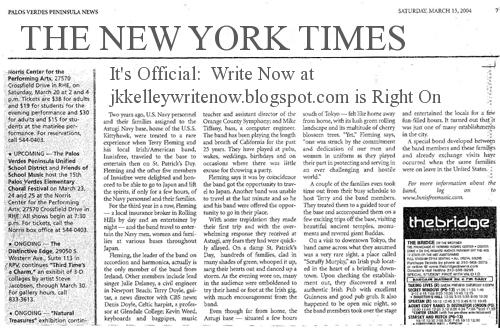
Welcome to Write Now


Click here for a message from Write Now's Press Agent.


Friday, August 25, 2006

Read all about it!

The New York Times has coverage on Write Now.


(Visit addletters.com to make your own self-aggrandizing news.)

Thursday, August 24, 2006

After Beef

I think my cow diversion has nearly runs its course.

The cows that decorate the world's major cities as part of the global public art movement, CowParade, are oddly fascinating. (See earlier blog: Car Parade: Budapest and Boston.)

I have spent too much time thinking about why people love these dressed up plaster bovines. But delight they do. Maybe it's the shared common form--your basic cow--transformed. You don't see a cow, you see how the cow was interpreted and that gives a jolt of pleasure as you impress yourself with your ability to understand the visual pun or message of the artist. People "get" this art. (In a way they don't get modern art?) This gives pleasure. Hence the cow parade goes on.

I can't help but think that in one hundred years, art historians will write books about early twenty-first century public art. Perhaps with the following title: "The Bovine Consciousness Emergent in Metropolitan Byways: A study." Or how about: "Heifers Rising: The Rise of Bovine Beauty in Early Twenty-first Century Urban Pastures."

But didn't I just say that my cow diversion was in its final throes of passion? Ready for the slaughter.

Let there be cows.

(Yet, it is so much more satisfying to write about parading cows than to attempt to write about the cow in the middle of my life, which is related to the elephant in the room, if you know what I mean.)

Vow to self: less caffeine, more tennis, less chatter, more keyboard clatter, and so forth.

Thursday, August 10, 2006

Cow Parade: Budapest and Boston


And so I decided to instead write about cows.

That is correct, cows.

The CowParade is a phenomenal public art success by most measures. If you have not yet experienced the parade of cows in a major metropolis, it is a public art moo-vement (forgive me) intended to make art accessible for the masses. Cows are safe. Have you met a person who did not like cows? We all love ‘em, and most of us happily eat them. (Pause and consider what that says about human nature.)

And then someone got the bright idea to use cows as a blank canvas. Artists in each city transform the same basic cow model into fantastic flights of imagination (or sadly, mere advertisements for the companies who sponsor them). Peter Hanig, the even coordinator explains:

Art is about breaking down barriers. It gets people to feel, to think, to react. So when you come across life-sized cow sculptures that have been covered in mirrors or gumdrops, cows that have been painted with elaborate themes or transformed into something else entirely, you can’t help but stop and think about what it means. All your preconceived ideas go out the window. Suddenly people see that art can be fun and that art can be interesting to everyone, not just people who frequent museums.

Art can be fun. Indeed. I am not sure what artists have to say about that, but I can imagine that some agree and some are not amoosed (sorry, I can’t help it, really.)

Peruse the CowParade website. It is a hoot. People love these cows. And the cows raise a huge amount of money for charity. It looks like a win-win game: artists get public exposure, charities get cash, and the art is temporary (so no one has to actually LIVE with it for longer than a summer).

The cows do reflect a city’s culture. Boston’s cows were upright, dignified chaps. Budapest’s cows—yes, they are hosting the parade this summer—are not of the Boston Breed. Strangely, however, the official CowParade website does not list Budapest as a participant. Odd. Is Budapest a renegade cow stampede? Two striking examples of cows in Budapest:

Handicap Cow: his two back legs were amputated and replaced by old-fashioned wheelchair wheels. Not exactly whimsical. Especially when a beggar with a similar impediment worked the subway stairs within sight.

And my personal favorite: The Ice-Cream Cow. The cow is located just near the traditional café for distinguished ladies and gents, the Gerbaund. (Update: I recently learned that this is its new location. It was moved here after much controversy. Read this article from Budapest's English weekly newspaper, Budapest Sun.) It is blue cow ice cream melting into the hot summer pavement. If you imagined a cow as ice-cream, where would you have to insert the wooden stick? Exactly. On the stick it says: Don’t Lick.

I love Budapest and its cows. Whimsical without the sentiment.

Another Update: I found the official Hungarian site for the CowParade. Check it out and dust off your Hungarian language skills! http://www.cowparade.hu/index2.html

(Photo credits go to my Dad and his first digital camera.)

Wednesday, August 09, 2006

One Hour to Madness and Joy

One Hour to Madness and Joy

by Walt Whitman

One hour to madness and joy! O furious! O confine me not!
(What is this that frees me so in storms?
What do my shouts amid lightnings and raging winds mean?)

O to drink the mystic deliria deeper than any other man!
O savage and tender achings! (I bequeath them to you my children,
I tell them to you, for reasons, O bridegroom and bride.)

O to be yielded to you whoever you are, and you to be yielded to me
in defiance of the world!
O to return to Paradise! O bashful and feminine!
O to draw you to me, to plant on you for the first time the lips of
a determin'd man.

O the puzzle, the thrice-tied knot, the deep and dark pool, all
untied and illumin'd!
O to speed where there is space enough and air enough at last!

To be absolv'd from previous ties and conventions, I from mine and
you from yours!
To find a new unthought-of nonchalance with the best of Nature!
To have the gag remov'd from one's mouth!
To have the feeling to-day or any day I am sufficient as I am.

O something unprov'd! something in a trance!
To escape utterly from others' anchors and holds!
To drive free! to love free! to dash reckless and dangerous!
To court destruction with taunts, with invitations!
To ascend, to leap to the heavens of the love indicated to me!
To rise thither with my inebriate soul!
To be lost if it must be so!
To feed the remainder of life with one hour of fulness and freedom!
With one brief hour of madness and joy.

Monday, August 07, 2006

Poem: August Morning

Summer travels are finished. We are back in the Bend for the school year. Our trip home from Budapest was smooth--no delays or lost luggage to complain of.

Settling into the house will take time after such a long time on the road. I do not look forward to the unpacking. In fact I am a notorious non-unpacker. I live out of my suitcase for weeks rather than face the laundry I should do sooner rather than later. Of course L. unpacks first thing.

To kick things up a notch, here is a lovely poem to savor:

American Life in Poetry: Column 071 BY TED KOOSER, U.S. POET LAUREATE, 2004-2006

William Carlos Williams, one of our country's most influential poets and a New Jersey physician, taught us to celebrate daily life. Here Albert Garcia offers us the simple pleasures and modest mysteries of a single summer day.

August Morning

It's ripe, the melon
by our sink. Yellow,
bee-bitten, soft, it perfumes
the house too sweetly.
At five I wake, the air
mournful in its quiet.
My wife's eyes swim calmly
under their lids, her mouth and jaw
relaxed, different.
What is happening in the silence
of this house? Curtains
hang heavily from their rods.
Ficus leaves tremble
at my footsteps. Yet
the colors outside are perfect--
orange geranium, blue lobelia.
I wander from room to room
like a man in a museum:
wife, children, books, flowers,
melon. Such still air. Soon
the mid-morning breeze will float in
like tepid water, then hot.
How do I start this day,
I who am unsure
of how my life has happened
or how to proceed
amid this warm and steady sweetness?

Poem copyright (c) by Albert Garcia from his latest book "Skunk Talk" (Bear Starr Press, 2005) and originally published in "Poetry East," No. 44. Reprinted by permission of the author. This weekly column is supported by The Poetry Foundation, The Library of Congress, and the Department of English at the University of Nebraska-Lincoln. This column does not accept unsolicited poetry.

Wednesday, August 02, 2006

Back in Budapest

My parents arrived in Transylvania on Friday morning and I have hardly had time to check my email never mind think about blogging.

It is a long, long trip from Kansas to the land of pine trees, mineral water, and kurtos kalach. They have been troopers, however. This morning we arrived back in Budapest via overnight train. In the couchette to our right was a film crew from England (including Jeremy Daniels--whose passport was confused with one of ours at the border), who had just finished shooting a film in Romania. On our right, a group of folk singers/story tellers from Hungary. My family took up an entire couchette.

Saturday and Sunday were spent on the pot-holed roads between villages and bigger cities in Transylvania. We visited a region famous for its salt mines, partially because my hometown in Kansas also has salt mines. We thought it would make for an interesting parallel view of the two cultures. We took a bus down into the mines for a few hours tour.

The mines we visited were huge caverns used here for health and recreation. It is considered therapeutic for those with respiratory problems to spend hours down inside the mines breathing the air which is certainly pollen free. None of us noticed an air ventilation system. No fire escapes. After the 1.5 kilometer bus ride down into the mine, we descended about 200 wooden steps. The experience was eerie. The mine is now equipped with picnic tables, swings, ping pong tables, and room for badminton. There is a church and a museum. And, of course, a coffee bar. (Other parts of the mine are still in working condition.)

After leaving the mines we spent the afternoon in nearby Szovata, a resort town with a salty-water lake. The lake is filled with bobbing heads due to the buoyancy of the water. We didn't float ourselves; instead we enjoyed a long, long lunch on a patio near the lake.

We fed my parents all the local foods we love: cheeses, cakes, fresh fruits and vegetables, mushrooms taken down from the mountains, micc (a kind of grilled meat), kurtos kalach, etc.

We took them up into the mountains around Csik to look at land we might want to buy. We drank Csiki beer on the main street and people watched. (We kept the gypsies at arm's length.)

We played with grandma's new puppy, Bodza.

On Monday we visited the church at Csiksomlyo, famous for its miraculous Virgin Mary statue.

We ate Grandma’s lunch at 1 pm everyday—roka mushrooms paprikas or chicken paprikas, puliszka, or potatoes, or perhaps sheep’s milk cheese and always enough perfectly ripe watermelon to feed an army.

Thanks be to God, the heat wave broke before we arrived in Budapest today. We are all happily ensconced in our castle district residences, most of us sleeping off lunch and rich servings of cake.

Things observed during this trip to Transylvania:

1. Roads in Transylvania are not just for cars--expect hay-loaded horse carts, motorcycles, bikes, old ladies walking, hitchhikers, train crossings operated by hand, hand-picked berries or mushrooms for sale, trucks, and the occasional grazing cow.

2. Kansas and Transylvania have more in common than you might expect.

3. Poverty does not equal danger or violence.

4. Language barriers can be overcome by walking a puppy on the street.

5. Poverty does not equal lack of education.

6. "Decarbonated" does not mean no carbonation when looking for water with no gas.

7. If you are willing to give your last piece of pizza to a beggar woman, do not feel shocked or offended when she walks two steps away and shares it with her son right before your eyes.

8. Transylvania and Budapest--not handicap accessible.

9. Puppies are worth it.